Manoeuvre only when it matters
Most alerts never needed action. We help you tell the ones that do from the ones that don't — before you commit propellant.
Orbital risk intelligence
Orbiture tells satellite operators which conjunction alerts actually matter.
The problem
Alert volumes in low Earth orbit climb every year. Each alert demands a decision — and every unnecessary manoeuvre costs propellant, operations time and mission life.
34,000+
objects tracked in Earth orbit today
10,700+
Starlink satellites alone, up from just two prototypes in 2018
1 in 2
tracked objects is debris or defunct, and every one can trigger an alert
Avoidance manoeuvres flown, one constellation
Nearly tripled in a single year. And each manoeuvre is only the end of a longer decision chain: NASA's conjunction assessment team alone has processed more than 11 million conjunction messages for a fleet of about 100 spacecraft.
Every one of those messages lands on an operations team that must read it, judge it and decide. That decision load is what Orbiture takes on, so rising congestion costs you less: safer satellites, less propellant spent, longer missions.
What you get
Orbiture provides orbital risk intelligence as a service. We work with the conjunction alerts you already receive and tell you which ones are worth a burn, with numbers you can defend. Your workflow stays yours; the stress of judging every alert does not.
Most alerts never needed action. We help you tell the ones that do from the ones that don't — before you commit propellant.
Every avoided burn returns fuel, operations hours and service days. Over the life of a fleet, that adds up to real mission lifetime.
Every recommendation arrives with a documented, quantified basis — for your flight director, your board, and your post-event review.
For operators
Every collision-avoidance manoeuvre you don't fly returns three things: the propellant you would have burned, the operations time you would have spent, and the service downtime you would have taken. Multiply that across a fleet and a decade of rising congestion, and honest risk numbers become one of the cheapest upgrades available to your operation.
Fewer burns
act only on the alerts that are real
Propellant kept
fuel budgeted for the mission, not for ghosts
Mission life back
more revenue days from every spacecraft
One constellation alone reported more than 207,000 avoidance manoeuvres in the last six months. If even a fraction of the industry's manoeuvres are answering false alarms, the waste is enormous, and it compounds every year.
For a 200-satellite Earth-observation fleet flying the ESA-average 1–3 avoidance manoeuvres per satellite per year, our conservative-to-central range says that if even 1 in 5 of those manoeuvres is answering an alert that never needed a burn, avoiding them is worth on the order of $87,000–$1.1 million a year and returns roughly 15–98 satellite-days of mission life — propellant your fleet keeps instead of spends.
Move the sliders to your own numbers. Nothing here is submitted or stored.
satellites
ESA LEO missions: 1–3 per satellite per year (Merz et al., 2017; ESA Space Debris Office). Large constellations report far more.
This one is our claim — and yours to doubt. Set it where you like.
Estimated saved per year
$87k–$1.1M
Mission-days regained per year
15–98 days
Estimates, not quotes. Ranges are conservative-to-central; your fleet's actuals will differ — that's the conversation.
Manoeuvre-rate averages from ESA Space Debris Office publications (Merz et al., 2017). The cost structure follows the operator cost model in NASA OTPS, Cost and Benefit Analysis of Orbital Debris Remediation (2023); the ranges themselves are Orbiture's own bottom-up estimates. Full workings available in conversation.
The sky right now
Both figures below are computed from today's public catalogue.
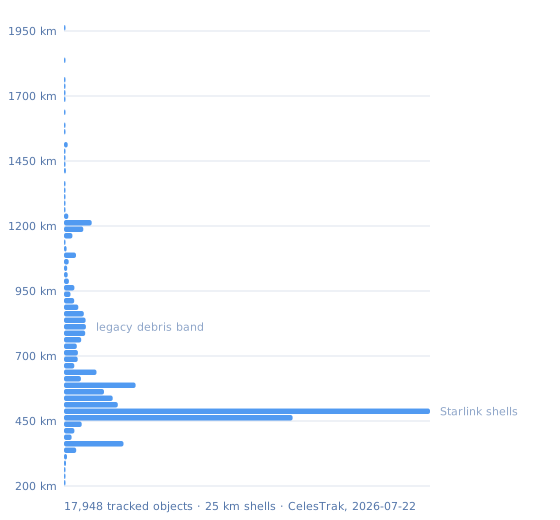
18,756
Open the live orbit view →The platform
We are building the shared risk layer for low Earth orbit. Operators plug their fleets into one platform, and every fleet that joins makes the assessments sharper and the service cheaper for everyone on it.
Get in touch
Join us in making orbit safer to operate in. Whether you fly one spacecraft or a constellation, we'd like to talk.
hello@orbiture.space